
Introduction
Jogging Track Construction UAE have become an important feature of modern outdoor spaces across the UAE. Residential communities, public parks, schools, hotels and sports complexes are increasingly incorporating dedicated jogging routes to encourage fitness and outdoor activities.
A well-designed jogging track provides a comfortable and accessible space for people to walk, jog and exercise. However, constructing a durable track requires more than simply preparing a pathway and applying a surface material. Route planning, ground preparation, drainage, surface selection and safety considerations all play an important role.
Jogging track construction in the UAE must also account for local weather conditions, high temperatures, sunlight exposure and occasional rainfall. Choosing suitable materials and following proper construction practices can help create a track that performs well over time.

1. Planning the Purpose and Location of the Jogging Track
The first stage of a jogging track project is understanding where it will be constructed and who will use it.
A jogging track in a residential community may be designed for everyday fitness and family recreation, while a track inside a sports complex may experience more frequent use.
Common locations include:
- Residential communities: Dedicated jogging routes for residents and families.
- Public parks: Recreational pathways connecting landscaped areas and outdoor activity zones.
- Schools and colleges: Tracks for student fitness and physical education.
- Hotels and resorts: Outdoor fitness facilities for guests.
- Sports complexes: Jogging routes supporting general fitness and athletic training.
The available space, expected user numbers, surrounding facilities and intended activity should be considered before finalising the design.
2. Jogging Track Design and Layout
A suitable layout helps users move comfortably while reducing conflicts with pedestrians, cyclists and vehicles.
Important design considerations include:
Track Length and Width
The required dimensions depend on the available land and the expected usage. A small community jogging loop will have different requirements from a larger recreational circuit.
The design should provide enough width for people moving in both directions, where applicable, and allow comfortable passing.
Route Shape
Jogging tracks can be designed as circular loops, oval routes or pathways connecting different parts of a development.
The route should avoid unnecessary sharp turns and sudden changes in elevation. Smooth curves help provide a more comfortable experience for regular users.
Access Points
Entry and exit points should be easy to identify and conveniently located. In larger facilities, multiple access points may be useful.
Integration with Other Facilities
A jogging track can be planned alongside cycling routes, landscaped areas, playgrounds and outdoor fitness zones. However, different activity routes should be clearly identified and separated where necessary.
3. Site Assessment and Ground Preparation
Proper ground preparation is essential for the long-term performance of a jogging track.
Before construction begins, the site should be assessed for soil condition, existing levels, drainage requirements, nearby structures and underground utilities.
The preparation process generally includes:
- Clearing vegetation, debris and unsuitable materials.
- Excavating the area to the required depth, where necessary.
- Preparing and compacting the subgrade.
- Installing the required sub-base according to the design.
- Checking levels, alignment and gradients.
- Preparing the base for the selected surface system.
A stable and properly compacted foundation helps reduce the risk of settlement, cracking and uneven surfaces.
The construction method should be selected according to the soil conditions, project specifications and expected usage.
4. Choosing the Right Jogging Track Surface
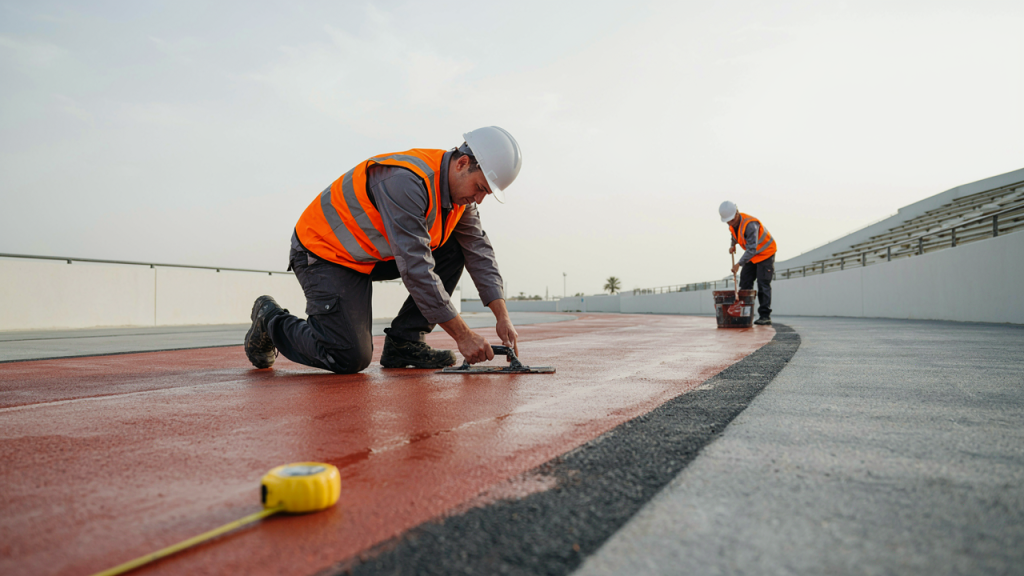
Surface selection is one of the most important decisions in a jogging track project. The chosen material affects running comfort, grip, durability, maintenance and overall project cost.
Different surface systems may be suitable for different applications.
Asphalt Surface
Asphalt is commonly used for outdoor pathways and recreational routes. It provides a firm and continuous surface and can be suitable for jogging tracks when properly designed and installed.
Its performance depends on the quality of the base, asphalt mix, compaction and drainage.
Rubberised Sports Surfaces
Certain rubberised systems can provide a more resilient surface compared with conventional hard pathways. They may be considered for recreational jogging areas where additional surface comfort is desired.
The system should be selected based on its intended use, thickness, texture and manufacturer’s recommendations.
Polyurethane (PU) Flooring
PU sports flooring systems are used in different sports applications and can offer a seamless finish. Certain systems may be suitable for specialised jogging or running facilities when designed for that purpose.
The surface specification should be matched to the expected activity and outdoor exposure.
EPDM Surface Systems
EPDM materials are available in different colours and configurations. They may be considered for selected recreational and outdoor activity areas.
However, not every EPDM playground flooring system is suitable for jogging. The material composition, surface texture and performance specifications should be evaluated before selection.
The best option depends on the track’s intended use, available budget, climate exposure and maintenance requirements.
5. Drainage and Water Management
Drainage is an important part of outdoor jogging track construction in the UAE.
Although the region experiences long periods of dry weather, occasional rainfall can cause water accumulation if the track does not have suitable gradients and drainage arrangements.
Poor drainage may affect the surface, weaken parts of the underlying base and create slippery conditions for users.
A well-planned drainage system should consider:
- Suitable surface gradients for water runoff.
- Drainage channels where required.
- Proper connection to the site’s drainage network.
- Prevention of water accumulation along track edges.
- Protection of nearby landscaped and recreational areas.
Drainage should be planned during the design stage rather than treated as an additional feature after the surface has been installed.
6. Safety Features for Jogging Tracks
Safety should be considered throughout the planning and construction process.
A properly designed jogging track should provide a clear and comfortable route for its intended users.
Some important safety features include:
Clear route markings: Markings and directional signs can help users understand the track layout.
Suitable surface texture: The selected material should provide appropriate grip for its intended activity and environmental conditions.
Smooth transitions: Connections between the jogging track and surrounding pathways should avoid sudden level differences.
Adequate lighting: Lighting is particularly important for facilities used during early mornings or evenings.
Pedestrian separation: Where jogging tracks run near cycling routes or vehicle access areas, suitable separation measures should be considered.
Accessible pathways: The layout should consider people with different mobility requirements wherever the project scope allows.
In schools and residential developments, additional attention should be given to children and other vulnerable users.
7. Jogging Track Construction for the UAE Climate
Outdoor tracks in the UAE are exposed to strong sunlight, high temperatures, dust and occasional rainfall. These conditions should influence material selection and construction planning.
Consider the following factors:
- UV resistance: Choose materials designed for prolonged outdoor sunlight exposure.
- Temperature performance: Check the manufacturer’s recommended operating temperature range.
- Surface durability: Select materials suited to the expected frequency and type of use.
- Drainage: Provide suitable water runoff to protect the base and finished surface.
- Maintenance: Consider cleaning requirements and the availability of repair materials.
Material specifications should be reviewed before installation to ensure that the selected system is appropriate for the project environment.
8. Maintenance of Jogging Tracks
Regular maintenance helps preserve the appearance, usability and performance of a jogging track.
A practical maintenance programme may include:
- Removing dust, sand, leaves and other debris.
- Inspecting the surface for cracks, wear and loose sections.
- Checking drainage channels and outlets.
- Maintaining route markings and directional signs.
- Inspecting transitions and track edges.
- Repairing damaged areas using compatible materials.
The inspection schedule should be based on usage levels, environmental conditions and the installed surface system.
Addressing minor defects early can help prevent more extensive repair work later.
9. Choosing the Right Jogging Track Construction Company in UAE
Selecting an experienced contractor is important for achieving a well-planned and durable outdoor facility.
Before appointing a contractor, consider:
- Experience in sports and outdoor recreational facility construction.
- Knowledge of different track surface systems.
- Ability to assess site and ground conditions.
- Proper planning for base preparation and drainage.
- Quality of materials and installation practices.
- Attention to finishing details and safety.
- Availability of maintenance and aftercare support.
A professional contractor should understand the project from the initial site assessment through to the final installation and inspection.
Anfield offers sports and outdoor facility solutions, including specific sports facilities. Project requirements can be evaluated according to the intended use, site conditions and selected surface system.
Conclusion
A successful jogging track is the result of careful planning, suitable material selection and proper construction practices. From the initial site assessment to ground preparation, drainage, surface installation and safety planning, every stage contributes to the overall quality of the facility.
Whether the project is for a residential community, public park, educational institution or sports complex, a well-designed jogging track can support everyday fitness and outdoor recreation.
For jogging track construction in the UAE, selecting suitable materials and working with an experienced sports facility contractor can help create a functional and durable outdoor space.
Frequently Asked Questions
1. What are the main stages of jogging track construction?
The main stages include site assessment, route planning, ground preparation, base construction, drainage planning, surface installation, marking and final inspection.
2. Which surface is best for an outdoor jogging track?
The best surface depends on the intended use, budget, climate exposure and project specifications. Asphalt and selected rubberised or specialist sports flooring systems may be considered for different applications.
3. Why is drainage important for jogging track construction?
Proper drainage helps prevent water accumulation, protects the underlying base and reduces the risk of slippery areas after rainfall.
4. Can jogging tracks be constructed in residential communities?
Yes. Jogging tracks can be incorporated into residential developments, parks and shared recreational spaces. Their layout should consider available land, user movement and separation from other activities.
5. How can jogging track maintenance requirements be reduced?
Choosing suitable materials, preparing a stable base, providing proper drainage and following a regular inspection schedule can help reduce avoidable maintenance issues.
6. What should be considered before installing a jogging track?
Important factors include the site conditions, track dimensions, intended users, surface material, drainage, safety features and long-term maintenance requirements.